Article
Practical Anesthetic Management of Mares in the Last Month of Gestation
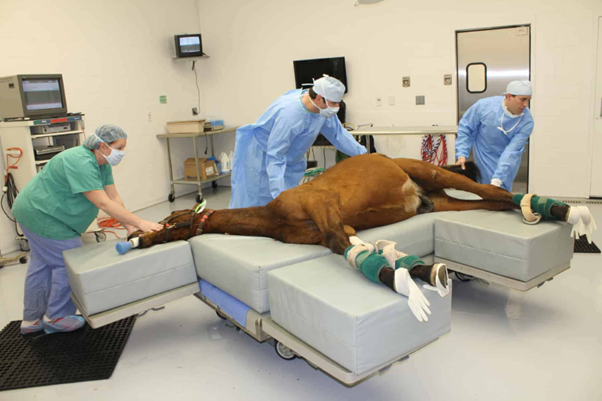
Abdominal surgery in a late-term pregnant mare is never just about the mare. Every anesthetic decision directly affects the fetus, and that makes perioperative management far more demanding than routine equine anesthesia.
Studies report viable foal survival rates of only 45–80% following abdominal surgery in pregnant mares, highlighting the delicate balance between maternal stabilization and fetal safety. The biggest fetal threat during anesthesia? Intrauterine hypoxia and asphyxia1,2.
Why Late-Term Mares Are High-Risk Anesthetic Patients
In the final trimester, the enlarged gravid uterus creates major physiologic challenges during inhalation anesthesia—especially in dorsal recumbency.
The uterus compresses1:
- The caudal vena cava → reducing venous return and preload
- The abdominal aorta → reducing uterine blood flow
- The diaphragm → impairing ventilation and gas exchange
The result is a dangerous combination of1:
- Hypotension
- Poor oxygenation
- Hypercarbia
- Reduced uteroplacental perfusion
- Potential fetal distress
Even with mechanical ventilation and 100% oxygen, maintaining adequate maternal oxygenation can be difficult.
The Blood Gas Changes You Cannot Ignore
One of the most clinically relevant findings in late-term mares under anesthesia is persistent respiratory compromise.
Key findings reported during anesthesia:
|
Parameter |
Clinical Concern |
|
Low PaO2 |
Inefficient oxygen exchange despite oxygen supplementation |
|
High PaCO2 (>60 mmHg) |
Hypoventilation and fetal acidosis risk |
|
Reduced blood pH |
Respiratory acidosis |
|
Persistent hypotension |
Compromised uteroplacental perfusion |
Hypercarbia is particularly important because fetal PaCO2 closely mirrors maternal PaCO2. As maternal carbon dioxide rises, fetal acidosis and cardiac depression may follow.
The study showed that by 75 minutes of anesthesia, mares demonstrated significant hypercarbia and worsening acidemia—strong indicators that prolonged anesthesia increases fetal risk1,3,4.
Dorsal Recumbency: The Hidden Problem
Dorsal recumbency significantly worsens cardiopulmonary compromise in pregnant mares.
Common consequences include1:
- Atelectasis
- Ventilation-perfusion mismatch
- Reduced functional residual capacity
- Decreased preload
- Negative central venous pressure
- Reduced stroke volume
Interestingly, cardiac output remained relatively stable because mares compensated with tachycardia. However, this compensation did not fully correct hypotension.
Clinically, this means a mare may appear cardiovascularly “stable” while uteroplacental perfusion is still inadequate.
What Happens to the Fetus?
The fetal response closely reflected maternal instability.
Observed fetal changes included1,3:
- Progressive fetal bradycardia
- Reduced fetal activity
- Correlation with maternal acidosis and elevated PaCO2
- Evidence of transient fetal distress
The study found that as maternal heart rate and PaCO2 increased, fetal heart rate decreased significantly.
This reinforces a critical practical point:
Fetal compromise during anesthesia is often secondary to poor maternal ventilation and perfusion—not simply anesthetic drug exposure.
Practical Anesthetic Pearls for Equine Practitioners
Minimize anesthesia duration
Prolonged inhalation anesthesia increases respiratory and cardiovascular compromise.
Avoid severe hypotension
Maintaining adequate mean arterial pressure is essential for uterine perfusion. Dobutamine support may be necessary throughout anesthesia.
Aggressively monitor ventilation
Pay close attention to:
- PaCO2
- PaO2
- Blood pH
- End-tidal CO2
Normocapnia should be a priority1.
Reconsider positioning when possible
Dorsal recumbency substantially worsens venous compression and pulmonary compromise in advanced pregnancy.
Monitor the fetus whenever feasible
Serial fetal heart rate assessment can provide early warning of fetal distress.
The Good News: Fetal Distress May Be Reversible
Despite significant trans-anesthetic fetal compromise, all foals in the study were ultimately born at term without complications.
Fetal heart rates normalized after maternal recovery, suggesting that rapid correction of maternal hypoxemia, hypercarbia, and hypotension can reverse fetal distress if addressed early.
Take-Home Message
Late-term pregnant mares undergoing inhalation anesthesia represent a true cardiopulmonary balancing act. The anesthetic challenge is not only keeping the mare stable—but maintaining adequate uteroplacental oxygen delivery throughout the procedure.
For equine surgeons and anesthetists, the major warning signs are:
- Rising PaCO2
- Falling pH
- Persistent hypotension
- Progressive fetal bradycardia
Careful monitoring, shorter anesthetic times, aggressive cardiovascular support, and optimized ventilation remain the keys to improving both mare and foal outcomes.
References
- Brito PH, Ferreira MA, Rusch E, Arantes JD, Carregaro AB, Valadão CA, Ghantous GF, Dória RG. Anesthesia for non-obstetric surgery during late term pregnancy in mares. Plos one. 2024 Nov 22;19(11):e0313563. https://doi.org/10.1371/journal.pone.0313563
- Upadya M, Saneesh PJ. Anaesthesia for non-obstetric surgery during pregnancy. Indian Journal of Anaesthesia. 2016, 60:234–41. https://doi.org/10.4103/0019-5049.179445
- Hubbell J.A.E. and Muir W.W. Monitoring Anesthesia. In: Muir W.W. and Hubbell J.A., Eds., Equine Anesthesia Monitoring and Emergency Therapy, Saunders Elsevier, St. Louis. 2009. p.149–170. https://doi.org/10.1016/b978-1-4160-2326-5.00008–0
- Taylor PM, Clarke KW. Anaesthesia in Special Situations. In: Taylor PM, Clarke KW. Eds., Handbook of equine anaesthesia. Saunders, Edinburgh. 2007, p. 177–207. https://doi.org/10.1016/B978-0-7020- 2835-9.50012–0
Related Contents
.jpg)
Video
Transjugular Removal of Canine Heartworms: A Clinical and Surgical Overview
Transjugular removal of canine heartworms is a specialized intervention used in selected dogs with s...

Article
Feline Pregnancy Endocrinology: Hormonal Changes and Placental Function
Pregnancy in cats involves a distinctive endocrine pattern in which ovarian and placental hormones w...

Article
Hormonal Control of Pregnancy Termination in Cats
Pregnancy maintenance in cats depends strongly on coordinated hormonal support, particularly progest...

Article
Feline Embryo Implantation and Early Placental Development
Pregnancy establishment in cats involves a sequence of precisely timed events between fertilization,...

Article
Ultrasonographic Monitoring of Pregnancy in Cats: A Gestational Timeline
Ultrasonography provides a practical way to follow the progression of feline pregnancy by identifyin...

Article
Feline Mismating: Pregnancy Diagnosis and Clinical Management
Mismating or unplanned mating is a common clinical problem in sexually mature queen cats because of...

Article
Medical Termination of Pregnancy in Queens: Drugs, Timing and Treatment Protocols
Medical termination of pregnancy (MTP) in queen cats should be approached according to the timing of...

Article
Safety and Aftercare Following Pregnancy Termination in Queen Cats
Pregnancy termination in queen cats requires more than selecting an appropriate abortifacient. Once...