Article
Hypertensive Emergency in Practice: Insights from a Retrospective Case Series of Dogs and Cats
Hypertensive emergency in dogs and cats remains a relatively underreported but clinically significant condition. Due to limited literature, much of the current understanding is derived from small case series and retrospective analyses. The available retrospective data provide valuable insights into the presentation, underlying causes, management, and outcomes of hypertensive emergency in veterinary patients.
Study Overview and Case Selection
This retrospective case series evaluated dogs and cats presenting with hypertensive emergency over a 16-year period. Cases were included based on the presence of severe hypertension (SBP >180 mmHg) accompanied by neurological signs, such as seizures, altered mentation, or acute blindness. Strict inclusion criteria ensured that only patients with confirmed hypertension and documented progression were analysed1.
Out of 303 initially identified cases, only 15 met the final inclusion criteria, reflecting both the rarity of the condition and the importance of accurate diagnosis and documentation.
Signalment and Patient Characteristics
The final study population consisted of seven dogs and eight cats. Dogs had a median age of 7 years, while cats were notably older, with a median age of 12 years. A range of breeds was represented, with no clear breed predisposition identified1.
Interestingly, survival appeared to vary with age. In dogs, survivors tended to be slightly older than non-survivors, whereas in cats, survivors were older than those that did not survive. Although the sample size limits definitive conclusions, these observations may reflect differences in disease progression or underlying conditions.
Clinical Presentation and Diagnostics
Clinical signs were typically acute, with a median duration of one day prior to presentation. Seizures were the most common presenting complaint, reinforcing their importance as a clinical indicator of hypertensive emergency.
Neurological examination revealed abnormalities in the majority of cases, including absent menace response, obtundation, anisocoria, and circling. Fundoscopic examination was equally informative, with abnormalities detected in 75% of evaluated patients. Retinal detachment was the most frequent finding, often correlating with visual deficits1.
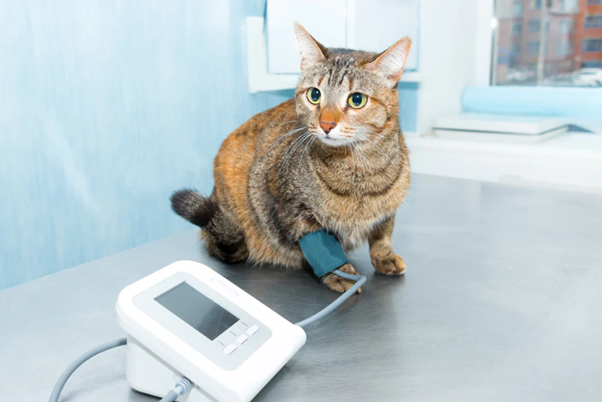
Blood pressure measurements confirmed severe hypertension in all cases. Dogs had a median admission SBP of 220 mmHg, while cats had a median of 230 mmHg, with peak values reaching as high as 300 mmHg1.
Laboratory findings frequently indicated renal dysfunction, with elevated creatinine levels observed in both species. Notably, higher creatinine concentrations were associated with poorer outcomes, particularly in dogs.
Underlying Causes
The most common underlying diagnosis in both dogs and cats was acute kidney injury. In cats, AKI accounted for 75% of cases, often due to acute-on-chronic kidney disease or ureteral obstruction. In dogs, AKI was also prominent, with causes including leptospirosis, intoxication, and immune-mediated glomerulonephritis1.
Other diagnoses included idiopathic hypertension, lymphoma, and suspected vascular conditions, highlighting the diverse aetiologies associated with hypertensive emergency.
Outcomes and Prognostic Indicators1
The overall in-hospital mortality rate was 46.7%, reflecting the severity of the condition. Mortality was higher in dogs than in cats, and most deaths were due to euthanasia rather than spontaneous cardiopulmonary arrest.
A key finding was the strong association between AKI and poor outcome. The majority of non-survivors had underlying renal disease, and in some cases, euthanasia was elected due to complications such as oligoanuria and fluid overload rather than progression of neurological signs.
Among survivors, blood pressure was successfully reduced to near-normal levels prior to discharge, with median SBP values of 140 mmHg in dogs and 160 mmHg in cats.
Clinical Relevance
This case series highlights several important considerations for veterinary practice. Hypertensive emergency, although uncommon, carries a high risk of mortality and requires prompt recognition and intervention. The strong association with renal disease underscores the importance of thorough diagnostic evaluation.
Perhaps most importantly, the variability in treatment approaches and outcomes reflects the lack of standardised guidelines in veterinary medicine. Until further research is available, clinicians must rely on careful monitoring, clinical judgement, and an understanding of disease progression.
Reference
- Beeston D, Jepson R, Cortellini S. Evaluation of presentation, treatment and outcome in hypertensive emergency in dogs and cats: 15 cases (2003‐2019). Journal of Small Animal Practice. 2022 Oct;63(10):784-91. https://onlinelibrary.wiley.com/doi/pdfdirect/10.1111/jsap.13530
Related Contents
.jpg)
Video
Transjugular Removal of Canine Heartworms: A Clinical and Surgical Overview
Transjugular removal of canine heartworms is a specialized intervention used in selected dogs with s...

Article
Feline Pregnancy Endocrinology: Hormonal Changes and Placental Function
Pregnancy in cats involves a distinctive endocrine pattern in which ovarian and placental hormones w...

Article
Hormonal Control of Pregnancy Termination in Cats
Pregnancy maintenance in cats depends strongly on coordinated hormonal support, particularly progest...

Article
Feline Embryo Implantation and Early Placental Development
Pregnancy establishment in cats involves a sequence of precisely timed events between fertilization,...

Article
Ultrasonographic Monitoring of Pregnancy in Cats: A Gestational Timeline
Ultrasonography provides a practical way to follow the progression of feline pregnancy by identifyin...

Article
Feline Mismating: Pregnancy Diagnosis and Clinical Management
Mismating or unplanned mating is a common clinical problem in sexually mature queen cats because of...

Article
Medical Termination of Pregnancy in Queens: Drugs, Timing and Treatment Protocols
Medical termination of pregnancy (MTP) in queen cats should be approached according to the timing of...

Article
Safety and Aftercare Following Pregnancy Termination in Queen Cats
Pregnancy termination in queen cats requires more than selecting an appropriate abortifacient. Once...