Article
Intravenous Fluid Therapy in Neonatal Calves With Diarrhea: Practical Clinical Approach
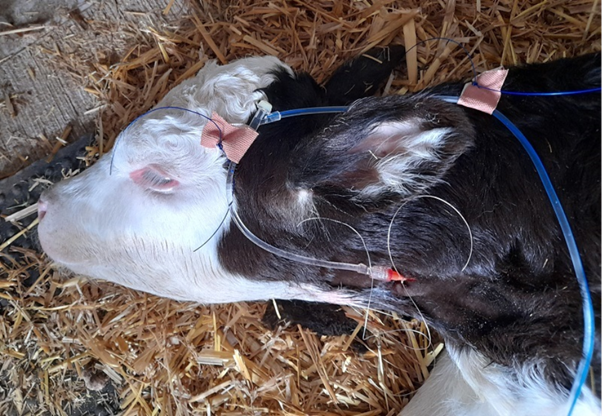
Intravenous (IV) fluid therapy in diarrheic neonatal calves is aimed at restoring circulating volume, correcting metabolic acidosis (pH <7.20), improving mentation and suckle reflex, correcting electrolyte imbalances, and addressing negative energy balance. Repair of intestinal mucosa is better supported through enteral nutrition rather than IV fluids1.
Key Pathophysiology for Clinical Decision-Making
Acidemia in neonatal calf diarrhea is primarily driven by hyponatremia and accumulation of unmeasured anions such as D-lactate1,2. Dehydration worsens this by reducing renal perfusion and acid excretion1. Fluid therapy should therefore prioritize sodium replacement and correction of metabolic acidosis.
Sodium Bicarbonate: First-Line in Acidemic Calves
Isotonic sodium bicarbonate (1.3%) is the preferred IV fluid in calves with moderate to severe acidemia (pH <7.20) (51). It provides rapid correction of acidosis and improves clinical status. Mildly hypertonic formulations (1.4%) may be used where additional sodium support is required1.
Hypertonic sodium bicarbonate (8.4%) is useful for rapid correction in severe cases but should be administered carefully at controlled infusion rates to avoid adverse effects1.
Use caution in calves with concurrent respiratory disease, as bicarbonate therapy may worsen hypercapnia in such cases.
Hypertonic Saline for Rapid Volume Expansion
Hypertonic saline (7.2–7.5% NaCl) administered at 4–5 ml/kg over 4–5 minutes is effective for rapid resuscitation in hypovolemic calves1. It improves cardiac output and perfusion by shifting fluid into the vascular space.
However, it does not correct metabolic acidosis and may transiently worsen acidemia. It is therefore best suited for calves without marked acidosis (pH >7.20) and should be followed by oral electrolyte therapy for sustained rehydration1,4.
Balanced Crystalloids: When to Use
Lactated Ringer’s solution may be used in calves with mild to moderate dehydration, particularly when acidosis is not severe1,5. Its alkalinizing effect is slower and may be less reliable in severely ill or hyperlactatemic calves1.
Acetated Ringer’s solution provides a similar role but may have limited alkalinizing effect and can cause mild vasodilation, which should be considered in unstable calves1,6.
Glucose Supplementation
Adding glucose (10 g/L) to initial IV fluids is beneficial in depressed calves, as hypoglycemia is common and associated with poor outcomes. Continued supplementation beyond the initial phase is not recommended due to reduced voluntary milk intake1,7.
Practical Treatment Approach
Clinical decisions should be based on standing ability, suckle reflex, hydration status (enophthalmos), and mentation1:
- Severe acidemia (pH <7.20): Sodium bicarbonate (isotonic or hypertonic)
- Hypovolemia without marked acidosis: Hypertonic saline followed by oral fluids
- Mild to moderate dehydration: Balanced crystalloids
Field Considerations
Availability of commercial bicarbonate solutions may be limited, and practitioners may need to prepare solutions using concentrated stock formulations. Close monitoring and reassessment are essential to guide ongoing therapy and avoid complications.
References
- Constable PD, Trefz FM, Sen I, Berchtold J, Nouri M, Smith G, Grünberg W. Intravenous and oral fluid therapy in neonatal calves with diarrhea or sepsis and in adult cattle. Frontiers in veterinary science. 2021 Jan 27;7:603358. https://doi.org/10.3389/fvets.2020.603358
- Trefz FM, Constable PD, Lorenz I. Quantitative physicochemical analysis of acid-base balance and clinical utility of anion gap and strong ion gap in 806 neonatal calves with diarrhea. Journal of veterinary internal medicine. 2015 Mar;29(2):678-87. https://doi.org/10.1111/jvim.12556
- Aydogdu U, Yildiz R, Guzelbektes H, Naseri A, Akyuz E, Sen I. Effect of combinations of intravenous small-volume hypertonic sodium chloride, acetate Ringer, sodium bicarbonate, and lactate Ringer solutions along with oral fluid on the treatment of calf diarrhea. Polish Journal of Veterinary Sciences. 2018;21(2).
- Aydogdu U, Yildiz R, Guzelbektes H, Naseri A, Akyuz E, Sen I. Effect of combinations of intravenous small-volume hypertonic sodium chloride, acetate Ringer, sodium bicarbonate, and lactate Ringer solutions along with oral fluid on the treatment of calf diarrhea. Polish Journal of Veterinary Sciences. 2018;21(2). https://journals.pan.pl/dlibra/publication/119048/edition/103592/content
- Doré V, Foster DM, Ru H, Smith GW. Comparison of oral, intravenous, and subcutaneous fluid therapy for resuscitation of calves with diarrhea. Journal of dairy science. 2019 Dec 1;102(12):11337-48. https://www.journalofdairyscience.org/article/S0022-0302(19)30896-3/fulltext
- Poll BG, Cheema MU, Pluznick JL. Gut microbial metabolites and blood pressure regulation: focus on SCFAs and TMAO. Physiology. 2020 Jul 1;35(4):275-84. https://doi.org/10.1152/physiol.00004.2020
- Trefz FM, Lorenz I, Lorch A, Constable PD. Clinical signs, profound acidemia, hypoglycemia, and hypernatremia are predictive of mortality in 1,400 critically ill neonatal calves with diarrhea. PloS one. 2017 Aug 17;12(8):e0182938. https://doi.org/10.1371/journal.pone.0182938
Related Contents
.jpg)
Video
Transjugular Removal of Canine Heartworms: A Clinical and Surgical Overview
Transjugular removal of canine heartworms is a specialized intervention used in selected dogs with s...

Article
Feline Pregnancy Endocrinology: Hormonal Changes and Placental Function
Pregnancy in cats involves a distinctive endocrine pattern in which ovarian and placental hormones w...

Article
Hormonal Control of Pregnancy Termination in Cats
Pregnancy maintenance in cats depends strongly on coordinated hormonal support, particularly progest...

Article
Feline Embryo Implantation and Early Placental Development
Pregnancy establishment in cats involves a sequence of precisely timed events between fertilization,...

Article
Ultrasonographic Monitoring of Pregnancy in Cats: A Gestational Timeline
Ultrasonography provides a practical way to follow the progression of feline pregnancy by identifyin...

Article
Feline Mismating: Pregnancy Diagnosis and Clinical Management
Mismating or unplanned mating is a common clinical problem in sexually mature queen cats because of...

Article
Medical Termination of Pregnancy in Queens: Drugs, Timing and Treatment Protocols
Medical termination of pregnancy (MTP) in queen cats should be approached according to the timing of...

Article
Safety and Aftercare Following Pregnancy Termination in Queen Cats
Pregnancy termination in queen cats requires more than selecting an appropriate abortifacient. Once...