Article
When Medical Management Fails: Surgical Decision-Making in Large Colon Displacements
While many large colon displacements respond favourably to conservative therapy, some horses deteriorate despite treatment and require prompt surgical intervention. Recognising these cases early can significantly improve outcomes and reduce the risk of life-threatening complications.
Identifying the Surgical Candidate
The decision to proceed with surgery is based on the horse’s clinical condition and response to medical management. Persistent or worsening abdominal pain despite analgesics and sedation is one of the most important indicators that conservative treatment may not be successful1.
Similarly, increasing abdominal distension, persistent gastric reflux, or escalating sedation requirements often signal the need for surgical exploration1.
Recognising Signs of Endotoxaemia
The development of endotoxaemia is another major warning sign.
Clinical findings that should raise concern include1:
- Hyperaemic mucous membranes
- Tachycardia
- Increasing packed cell volume
- Concurrent hypoproteinaemia
- Cold extremities
These findings often indicate more severe gastrointestinal compromise and frequently justify surgical intervention.
Diagnostic Clues That Medical Therapy May Fail
Additional factors supporting surgical management include1:
- Abnormal abdominocentesis results
- Severe gas distension that limits rectal examination
- Persistent discomfort despite ongoing treatment
These findings suggest that the displacement is unlikely to resolve conservatively and may be associated with more significant intestinal pathology.
Surgical Correction of Large Colon Displacements
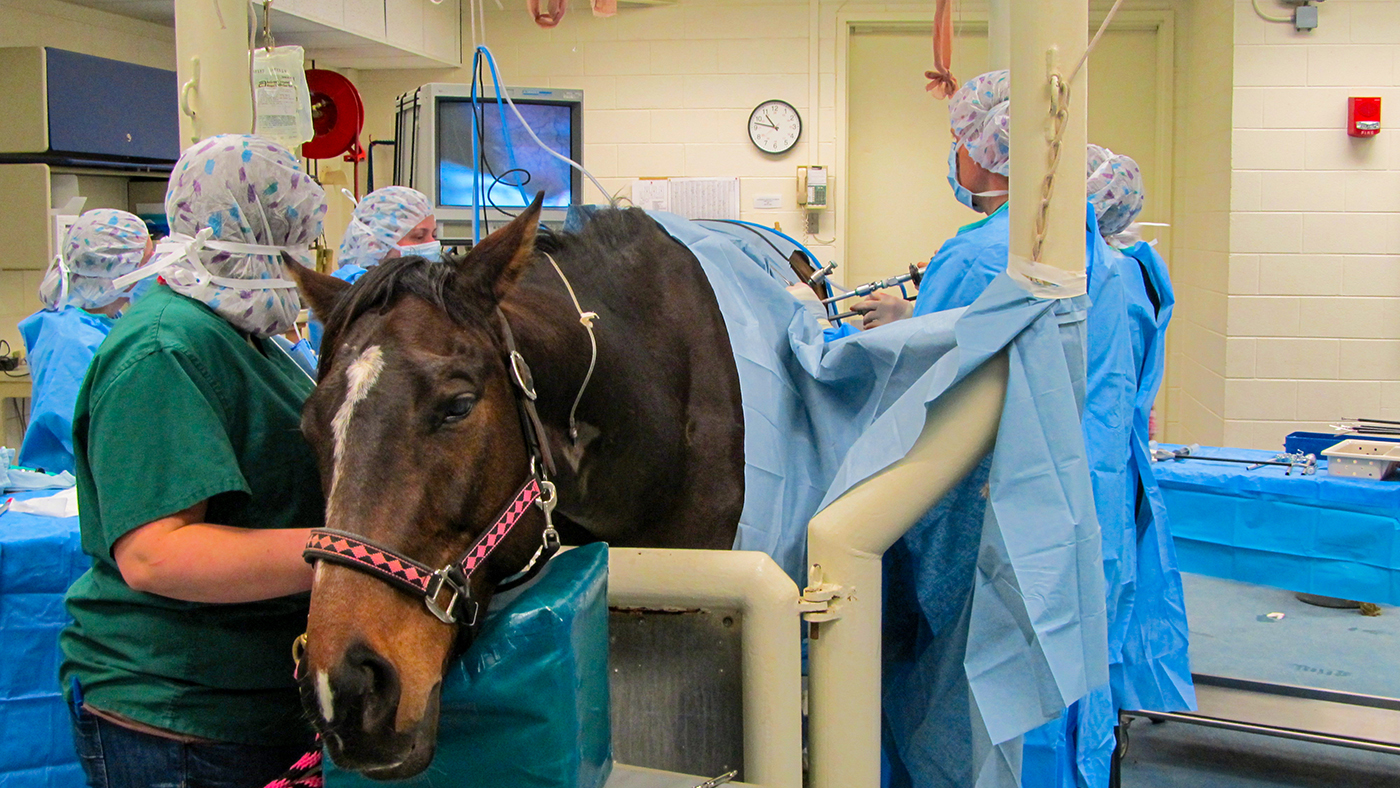
Horses diagnosed with right dorsal displacement, 180-degree volvulus, or retroflexion of the pelvic flexure generally require surgical correction through a ventral midline or paramedian laparotomy2.
The primary goals of surgery are to1:
- Restore normal colon positioning
- Assess intestinal viability
- Identify concurrent gastrointestinal lesions
- Address associated impactions when present
In many cases, enterotomy and lavage are required to remove accumulated ingesta and reduce the likelihood of postoperative complications.
Choosing the Surgical Approach
Many surgeons favour a ventral midline laparotomy because it allows complete exploration of the abdominal cavity and facilitates management of concurrent abnormalities1.
Standing flank procedures may be appropriate in selected horses with nephrosplenic entrapment and can allow simultaneous nephrosplenic space ablation3. However, these procedures are generally unsuitable for horses experiencing severe pain, marked impactions, or suspected additional intestinal disease1.
What Does the Prognosis Look Like?
Fortunately, outcomes following treatment of large colon displacements are generally favourable.
For left dorsal displacement, overall survival rates range from 90% to 100% across all treatment methods4. Surgical correction specifically has reported success rates between 80% and 95.9%5.
For right dorsal displacement, overall success rates approach 94%, while surgical success rates range between 80% and 93%1.
These figures highlight the excellent prognosis that can often be achieved when appropriate intervention occurs before significant intestinal compromise develops.
Why Early Referral Matters
Delays in referral can increase the risk of progressive distension, endotoxaemia, intestinal injury, and more complex surgical procedures. Early recognition of cases that are unlikely to respond medically allows timely intervention and may improve both survival and long-term athletic outcomes1.
Clinical Takeaway
The challenge in managing large colon displacements lies not only in treating the condition but also in recognising when conservative therapy is no longer appropriate. Persistent pain, worsening distension, endotoxaemia, and abnormal diagnostic findings should prompt consideration of surgical intervention. With timely referral and appropriate surgical management, prognosis for most horses remains excellent.
References
- Munsterman A. Lefts and rights: Medical management of colonic displacements. Dvm360storage. com. 2025. https://www.mmhimages.com/
- Silva LC, Zoppa AL, Hendrickson DA. Equine diagnostic laparoscopy. Journal of equine veterinary science. 2008 Apr 1;28(4):247-54. https://www.academia.edu/download/107577378/j.jevs.2008.02.00220231120-1-hnb1gi.pdf
- Dias AB. Recurrent nephrosplenic entrapment: a review of cases, shorterm and longterm outcome after laparoscopic nephrosplenic space closure with barbed knotless suture in horses. PQDT-Global. 2021. https://repositorio.ulisboa.pt/bitstreams/dac7fe1e-ca8d-4ad5-b361-7bed1a6566a9/download
- Fultz LE, Peloso JG, Giguère S, Adams AR. Comparison of phenylephrine administration and exercise versus phenylephrine administration and a rolling procedure for the correction of nephrosplenic entrapment of the large colon in horses: 88 cases (2004–2010). Journal of the American Veterinary Medical Association. 2013 Apr 15;242(8):1146-51. https://doi.org/10.2460/javma.242.8.1146
- Lindegaard C, Ekstrøm CT, Wulf SB, Vendelbo JM, Andersen PH. Nephrosplenic entrapment of the large colon in 142 horses (2000–2009): analysis of factors associated with decision of treatment and short‐term survival. Equine veterinary journal. 2011 Aug;43:63-8. https://doi.org/10.1111/j.2042-3306.2011.00376.x
Related Contents
.jpg)
Video
Transjugular Removal of Canine Heartworms: A Clinical and Surgical Overview
Transjugular removal of canine heartworms is a specialized intervention used in selected dogs with s...

Article
Feline Pregnancy Endocrinology: Hormonal Changes and Placental Function
Pregnancy in cats involves a distinctive endocrine pattern in which ovarian and placental hormones w...
Article
Hormonal Control of Pregnancy Termination in Cats
Pregnancy maintenance in cats depends strongly on coordinated hormonal support, particularly progest...
Article
Feline Embryo Implantation and Early Placental Development
Pregnancy establishment in cats involves a sequence of precisely timed events between fertilization,...
Article
Ultrasonographic Monitoring of Pregnancy in Cats: A Gestational Timeline
Ultrasonography provides a practical way to follow the progression of feline pregnancy by identifyin...

Article
Feline Mismating: Pregnancy Diagnosis and Clinical Management
Mismating or unplanned mating is a common clinical problem in sexually mature queen cats because of...
Article
Medical Termination of Pregnancy in Queens: Drugs, Timing and Treatment Protocols
Medical termination of pregnancy (MTP) in queen cats should be approached according to the timing of...

Article
Safety and Aftercare Following Pregnancy Termination in Queen Cats
Pregnancy termination in queen cats requires more than selecting an appropriate abortifacient. Once...