Article
Clinical Approach to Hypertension: Causes, Types & Diagnosis
Hypertension in dogs and cats is often a silent yet clinically significant condition that frequently goes undetected until target organ damage becomes evident. Unlike in human medicine, where routine screening is common, blood pressure measurement in veterinary practice is still inconsistently performed. This makes a structured clinical approach, focused on causes, classification, and diagnosis, critical for timely intervention and improved outcomes.
Understanding the Clinical Burden of Hypertension
Hypertension is defined as a persistent elevation in blood pressure, typically exceeding 140/90 mmHg, and is associated with increased risk of cardiovascular and systemic complications1,2. In small animals, it is rarely an isolated condition. Most cases are secondary to underlying disease, particularly renal and endocrine disorders.
In dogs, hypertension may affect up to 10% of the population, while a significant proportion of animals with renal disease, ranging from 31 to 93% in dogs and 20 to 60% in cats, may develop hypertension1. Despite this, clinical signs are often subtle or absent in early stages.
Etiological Classification: Primary vs Secondary Hypertension
A key step in clinical evaluation is distinguishing between primary (essential) and secondary hypertension.
Primary Hypertension
Primary hypertension refers to elevated blood pressure with no identifiable underlying cause. Although well recognized in human medicine, it is less common in veterinary patients. When present, it is often associated with predisposing factors such as age, obesity, high-salt diet, sedentary lifestyle, and genetic susceptibility3.
Over time, persistent pressure elevation can lead to vascular damage, increasing the risk of complications such as cardiac disease, renal impairment, neurological disorders, and vision loss.
Secondary Hypertension
Secondary hypertension is far more common in dogs and cats and results from identifiable underlying conditions. The most significant contributors include:
- Chronic kidney disease, the leading cause in both species
- Endocrine disorders, such as hyperthyroidism, hyperaldosteronism, and Cushing’s disease
- Diabetes mellitus, particularly with renal involvement
- Adrenal gland tumors, including pheochromocytoma
- Renovascular disease, involving narrowing of renal arteries
In these cases, effective management depends on addressing the primary disease. Hypertension often improves or resolves once the underlying condition is controlled1.
White Coat Hypertension: A Diagnostic Challenge
An important clinical consideration is white coat hypertension, where blood pressure is elevated in a clinical setting but normal in a relaxed environment. This phenomenon is attributed to stress and sympathetic activation during examination1.
While often considered benign, it should not be dismissed outright. Repeated measurements and proper technique are essential to differentiate transient stress-induced elevation from persistent hypertension.
Clinical Presentation: What to Look For
Hypertension in small animals is frequently asymptomatic until complications arise. When clinical signs are present, they often reflect target organ damage.
In dogs, one of the most noticeable signs is sudden or progressive vision loss, often due to retinal hemorrhage or detachment. In cats, visual abnormalities are also common and may include dilated pupils, intraocular bleeding, and impaired light response1.
Other associated clinical signs may include:
- Increased thirst and urination
- Weight loss and vomiting
- Neurological signs such as seizures or altered behavior
- Cardiovascular abnormalities such as murmurs
These signs are typically linked to the underlying disease rather than hypertension alone.
Diagnostic Approach in Practice
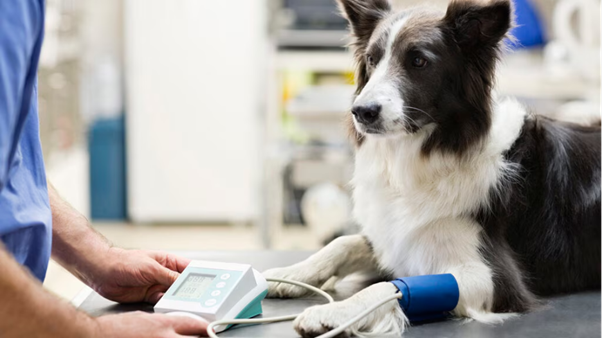
Accurate diagnosis of hypertension requires more than a single elevated reading. Blood pressure should be measured under calm conditions, ideally using validated techniques and repeated assessments to confirm persistence.
Equally important is identifying the underlying cause. A thorough diagnostic workup should include:
- Renal function evaluation
- Endocrine testing where indicated
- Imaging studies for suspected adrenal or vascular abnormalities
This integrated approach ensures that hypertension is not managed in isolation but as part of a broader systemic condition1.
Therapeutic Considerations
Management of hypertension involves both symptomatic control and treatment of the underlying disease. Commonly used medications include:
- Angiotensin-converting enzyme (ACE) inhibitors
- Calcium channel blockers
- Vasodilators
These therapies help reduce vascular resistance, control fluid balance, and protect target organs. However, without addressing the primary cause, long-term control may remain suboptimal1.
Conclusion
Hypertension in dogs and cats is a multifactorial condition that requires a structured clinical approach. Differentiating between primary and secondary forms, recognizing subtle clinical signs, and identifying underlying causes are essential steps in effective management.
For veterinarians, the key lies in shifting from reactive to proactive care. Routine blood pressure monitoring, combined with targeted diagnostics, can significantly improve early detection and reduce the risk of irreversible organ damage.
References
- Adejumobi OA, Jeremiah OT, Omobowale TO. Blood pressure regulation and mechanism of hypertension development in dogs and cats: A review. Journal of Animal Science and Veterinary Medicine. 2022 Jun;7(3):103-12. https://www.academia.edu/download/99881610/342C36656.pdf
- Atefi M, Ghavami A, Hadi A, Askari G. The effect of barberry (Berberis vulgaris L.) supplementation on blood pressure: A systematic review and meta-analysis of the randomized controlled trials. Complementary Therapies in Medicine. 2021 Jan 1;56:102608. https://www.sciencedirect.com/science/article/pii/S0965229920318756
- Saxton SN, Clark BJ, Withers SB, Eringa EC, Heagerty AM. Mechanistic links between obesity, diabetes, and blood pressure: role of perivascular adipose tissue. Physiological reviews. 2019 Oct 1;99(4):1701-63. https://journals.physiology.org/doi/pdf/10.1152/physrev.00034.2018
Related Contents
.jpg)
Video
Transjugular Removal of Canine Heartworms: A Clinical and Surgical Overview
Transjugular removal of canine heartworms is a specialized intervention used in selected dogs with s...

Article
Feline Pregnancy Endocrinology: Hormonal Changes and Placental Function
Pregnancy in cats involves a distinctive endocrine pattern in which ovarian and placental hormones w...

Article
Hormonal Control of Pregnancy Termination in Cats
Pregnancy maintenance in cats depends strongly on coordinated hormonal support, particularly progest...

Article
Feline Embryo Implantation and Early Placental Development
Pregnancy establishment in cats involves a sequence of precisely timed events between fertilization,...

Article
Ultrasonographic Monitoring of Pregnancy in Cats: A Gestational Timeline
Ultrasonography provides a practical way to follow the progression of feline pregnancy by identifyin...

Article
Feline Mismating: Pregnancy Diagnosis and Clinical Management
Mismating or unplanned mating is a common clinical problem in sexually mature queen cats because of...

Article
Medical Termination of Pregnancy in Queens: Drugs, Timing and Treatment Protocols
Medical termination of pregnancy (MTP) in queen cats should be approached according to the timing of...

Article
Safety and Aftercare Following Pregnancy Termination in Queen Cats
Pregnancy termination in queen cats requires more than selecting an appropriate abortifacient. Once...