Article
Early Recognition of Diabetes Mellitus in Cats: Practical Strategies for Timely Diagnosis
Diabetes mellitus (DM) is one of the most common endocrinopathies encountered in feline practice, and its prevalence is believed to be increasing. Although treatment options have expanded considerably, achieving favorable outcomes still depends heavily on recognizing affected cats before prolonged hyperglycaemia leads to complications. Early diagnosis not only improves clinical management but may also increase the likelihood of diabetic remission and reduce the risk of significant weight loss and metabolic complications1,2,3,4.
Identifying Cats at Increased Risk
Routine wellness examinations provide an ideal opportunity to identify cats that may be at increased risk of developing DM. Increasing age remains the most important risk factor, with most affected cats being diagnosed after 8 years of age and incidence peaking between 10 and 13 years1,3,5,6.
Several additional factors should prompt greater clinical vigilance6:
- Obesity, which contributes to insulin resistance and substantially increases the risk of DM.
- Neutered male cats, which are affected more frequently than neutered females, even after accounting for body weight.
- Indoor confinement and low levels of physical activity.
- Burmese cats in some geographical regions, where breed predisposition has been recognized.
Senior health assessments that include regular body weight recording, body condition scoring, and routine urinalysis can help identify subtle changes before overt clinical disease develops.
Recognising the Clinical Picture
The classic presentation remains familiar to most veterinarians: polyuria, polydipsia, weight loss despite polyphagia, and lethargy. However, clinical presentation is not always straightforward.
Concurrent diseases commonly influence appetite and clinical appearance. For example, cats with chronic kidney disease or pancreatitis may not exhibit polyphagia, while prolonged hyperglycaemia may result in diabetic neuropathy with a characteristic plantigrade stance6. In more advanced cases, diabetic ketoacidosis may be the initial presentation, with vomiting, inappetence, dehydration, and marked systemic illness requiring immediate intervention.
Maintaining a broad clinical perspective is therefore essential, particularly in older cats with multiple comorbidities.
Applying Practical Diagnostic Criteria
The guideline emphasizes avoiding premature diagnosis based solely on a single elevated blood glucose measurement because stress hyperglycaemia can occur in cats and may be of any magnitude7.
Diagnosis should integrate compatible clinical findings with objective laboratory evidence. According to the ALIVE criteria, diagnosis is supported by persistent hyperglycaemia together with increased glycated proteins or repeated glucosuria identified from naturally voided urine collected in the home environment after stressful events have resolved7.
Serum fructosamine provides an assessment of average blood glucose over approximately the preceding 7–10 days and is less influenced by acute stress. Interpretation should always consider conditions that alter serum protein turnover, as these may falsely increase or decrease fructosamine concentrations6,8.
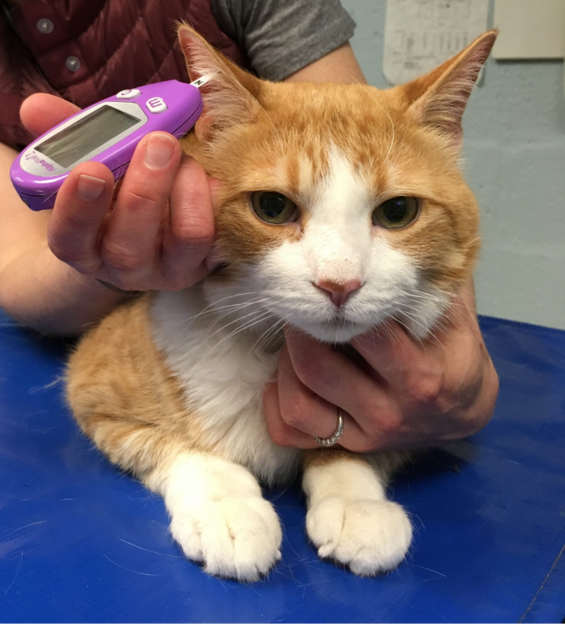
Where uncertainty remains, home blood glucose monitoring, continuous glucose monitoring (CGM), or repeated home urine glucose testing can help distinguish true DM from transient stress hyperglycaemia7.
Promoting Earlier Detection in Practice
Earlier diagnosis often begins outside the consultation room. Encouraging caregivers to monitor body weight at home, educating them about early clinical signs, and recommending urine glucose testing for at-risk cats can facilitate earlier presentation.
Senior wellness clinics also provide opportunities to identify unexplained weight loss, obesity, or glucosuria before severe hyperglycaemia develops. These proactive measures allow treatment to begin before complications become established, improving overall clinical outcomes9.
Practical Clinical Insights
Early recognition of feline diabetes extends beyond identifying classic clinical signs. A structured approach that combines risk assessment, careful interpretation of laboratory findings, and ongoing communication with caregivers allows veterinarians to detect disease before advanced metabolic disturbances occur. Incorporating routine screening into senior health programmes and avoiding over-reliance on single blood glucose measurements can improve diagnostic confidence while supporting timely intervention and long-term management.
References
- O'neill DG, Gostelow R, Orme C, Church DB, Niessen SJ, Verheyen K, Brodbelt DC. Epidemiology of diabetes mellitus among 193,435 cats attending primary-care veterinary practices in England. Journal of veterinary internal medicine. 2016 Jul;30(4):964-72. https://academic.oup.com/jvim/article-pdf/30/4/964/66690080/jvim14365.pdf
- Öhlund M, Fall T, Ström Holst B, Hansson-Hamlin H, Bonnett B, Egenvall A. Incidence of diabetes mellitus in insured Swedish cats in relation to age, breed and sex. Journal of Veterinary Internal Medicine. 2015 Sep;29(5):1342-7. https://academic.oup.com/jvim/article-pdf/29/5/1342/66687335/jvim13584.pdf
- Prahl A, Guptill L, Glickman NW, Tetrick M, Glickman LT. Time trends and risk factors for diabetes mellitus in cats presented to veterinary teaching hospitals. Journal of feline medicine and surgery. 2007 Oct;9(5):351-8. https://journals.sagepub.com/doi/pdf/10.1016/j.jfms.2007.02.004
- Marshall RD, Rand JS, Morton JM. Treatment of newly diagnosed diabetic cats with glargine insulin improves glycaemic control and results in higher probability of remission than protamine zinc and lente insulins. Journal of feline medicine and surgery. 2009 Aug;11(8):683-91. https://journals.sagepub.com/doi/pdf/10.1016/j.jfms.2009.05.016
- Guse B, Langenstein J, Bauer N, Hazuchova K. Signalment, clinicopathological findings, management practices and comorbidities in cats with diabetes mellitus in Germany: cross-sectional study of 144 cases. Journal of Feline Medicine and Surgery. 2025 Jan;27(1):1098612X241303303. https://journals.sagepub.com/doi/pdf/10.1177/1098612X241303303
- Taylor S, Cannon M, Church D, Fleeman L, Fracassi F, Gilor C, Mott J, Niessen S. 2025 iCatCare consensus guidelines on the diagnosis and management of diabetes mellitus in cats. Journal of feline medicine and surgery. 2025 Nov;27(11):1098612X251399103. https://journals.sagepub.com/doi/pdf/10.1177/1098612X251399103
- Niessen SJ, Bjornvad C, Church DB, Davison L, Esteban-Saltiveri D, Fleeman LM, Forcada Y, Fracassi F, Gilor C, Hanson J, Herrtage M. Agreeing Language in Veterinary Endocrinology (ALIVE): Diabetes mellitus-a modified Delphi-method-based system to create consensus disease definitions. The Veterinary Journal. 2022 Nov 1;289:105910. https://www.sciencedirect.com/science/article/pii/S1090023322001253
- Gal A, Trusiano B, French AF, Lopez-Villalobos N, MacNeill AL. Serum fructosamine concentration in uncontrolled hyperthyroid diabetic cats is within the population reference interval. Veterinary sciences. 2017 Mar 15;4(1):17. https://www.mdpi.com/2306-7381/4/1/17
- Marshall RD, Rand JS, Morton JM. Treatment of newly diagnosed diabetic cats with glargine insulin improves glycaemic control and results in higher probability of remission than protamine zinc and lente insulins. Journal of feline medicine and surgery. 2009 Aug;11(8):683-91. https://journals.sagepub.com/doi/pdf/10.1016/j.jfms.2009.05.016
Related Contents
Article
FGF-23 in Feline CKD: An Early Signal of Phosphate Dysregulation
A cat with early chronic kidney disease (CKD) may have a normal serum phosphate concentration. Does...
Article
Albuminuria or Transferrinuria? Reading the Glomerular Signal in Feline CKD
A cat can have chronic kidney disease (CKD) with only mild proteinuria. So, when urinary protein is...
Article
Tubular Injury Biomarkers in Feline CKD: What Can NGAL, KIM-1 and L-FABP Tell You?
When feline CKD is already suspected, identifying reduced renal function is only part of the clinica...
Article
Can Renal Fibrosis Biomarkers Reveal CKD Progression in Cats?
Chronic kidney disease in cats is not only a problem of declining renal function. Structural changes...
Article
When Creatinine May Not Tell the Full Story in Feline Acute Kidney Injury
Serum creatinine is routinely used with changes in urine output to diagnose and grade Acute Kidney I...
Article
When a Normal-Looking Udder Hides Mastitis: Recognising Subclinical Mastitis in Buffaloes
A buffalo can appear clinically normal while mastitis is already affecting the udder and milk produc...

Article
Buffalo Subclinical Mastitis: Which Risk Factors Should Vets Investigate?
When subclinical mastitis (SCM) keeps appearing in a buffalo herd, looking only at the affected anim...
Article
Diagnosing Subclinical Mastitis in Buffaloes: From SCC and CMT to Molecular Tests
Subclinical mastitis (SCM) can remain hidden because the buffalo may show no obvious udder or milk a...