Article
Managing Hypertensive Emergency in Dogs and Cats: Practical Treatment Insights from Clinical Data
Hypertensive emergency in veterinary patients presents a significant therapeutic challenge due to its acute, life-threatening nature and the lack of well-defined treatment guidelines. While human medicine offers structured protocols, their applicability to dogs and cats remains uncertain. As a result, management in veterinary practice often relies on clinical judgement, available resources, and individual patient response.
The primary goal of treatment is the controlled reduction of blood pressure to limit ongoing target organ damage while avoiding excessive decreases that may compromise perfusion. Human guidelines recommend reducing mean arterial pressure by 20–25% within the first hour, followed by gradual reduction over subsequent hours1,2. However, the suitability of these targets in veterinary patients remains unclear, highlighting the need for cautious, individualised management.
Initial Therapeutic Approach
In clinical settings, treatment choices are often guided by drug availability and practicality. Amlodipine is commonly used and frequently selected as a first-line agent.
As a calcium channel blocker acting on vascular smooth muscle, amlodipine is well established for chronic hypertension1. However, its use in hypertensive emergency is less ideal due to its slower onset of action. Both veterinary and human guidelines suggest it is more appropriate for hypertensive urgency rather than emergency1,3.
Despite this limitation, its widespread use reflects real-world constraints, particularly the limited availability of fast-acting parenteral agents. This reinforces the gap between ideal pharmacological management and what is practically achievable in many veterinary settings.
Role of Parenteral Antihypertensives
Parenteral antihypertensive agents are preferred in acute settings due to their rapid onset and titratability, allowing closer control of blood pressure.
Hydralazine is one of the more commonly used agents in this context. It acts as a direct vasodilator of arteriolar smooth muscle1 and is typically administered as intermittent boluses, sometimes followed by continuous infusion.
However, its use requires caution. In human medicine, hydralazine is no longer recommended for hypertensive emergency because of its unpredictable response and prolonged action1. In veterinary patients, the lack of pharmacokinetic data further complicates its use, making careful monitoring essential.
Sodium nitroprusside represents another option for rapid blood pressure control. As a potent vasodilator, it can achieve quick reductions, but its use is associated with several limitations. These include difficulty in titration, risk of hypotension, requirement for light-protected handling, and potential for cyanide toxicity with prolonged administration1. Its tendency to increase intracranial pressure also makes it less suitable in patients with hypertensive encephalopathy.
Limitations in Drug Availability
A major challenge in veterinary medicine is the limited access to several agents commonly used in human hypertensive emergency. Drugs such as labetalol, nicardipine, and clevidipine are not routinely used, largely due to availability and lack of veterinary-specific data.
Clevidipine, in particular, is considered highly effective in human medicine due to its rapid onset and short duration of action, but remains largely inaccessible in veterinary practice. Similarly, fenoldopam, which may be beneficial in patients with renal compromise, is difficult to obtain1.
These limitations highlight the gap between theoretical recommendations and practical implementation in veterinary settings.
Monitoring and Treatment Response
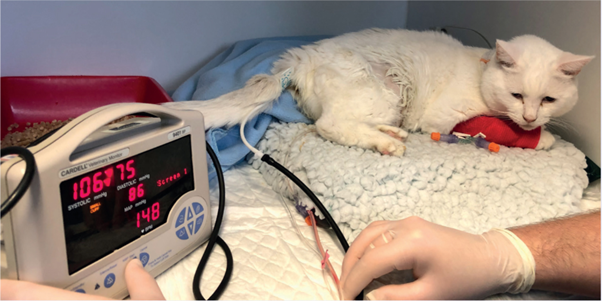
Effective management depends on close monitoring of blood pressure and timely adjustment of therapy. Achieving rapid reductions, as suggested in human guidelines, is often challenging in veterinary patients.
In many cases, blood pressure reduction occurs more gradually. This variability emphasises the importance of an individualised approach, as overly rapid correction may lead to hypoperfusion and worsen organ damage. Continuous assessment of response is therefore critical to guide treatment decisions.
Clinical Implications
Hypertensive emergency requires a careful balance between urgency and control. While oral agents such as amlodipine are commonly used, their limitations in acute settings must be recognised. Parenteral therapies offer advantages but come with practical and safety challenges.
In the absence of clear veterinary-specific guidelines, clinicians must rely on clinical judgement, careful monitoring, and an understanding of drug limitations. A tailored approach based on patient response and underlying disease remains essential for improving outcomes.
Reference
- Beeston D, Jepson R, Cortellini S. Evaluation of presentation, treatment and outcome in hypertensive emergency in dogs and cats: 15 cases (2003‐2019). Journal of Small Animal Practice. 2022 Oct;63(10):784-91. https://onlinelibrary.wiley.com/doi/pdfdirect/10.1111/jsap.13530
- Whelton, P. K., Carey, R. M., Aronow, W. S., et al. (2018) 2017 ACC/AHA/AAPA/ ABC/ACPM/AGS/APhA/ASH/ ASPC/NMA/PCNA guideline for the prevention, detection, evaluation, and management of high blood pressure in adults: executive summary: a report of the American College of Cardiology/American Heart Association Task Force on clinical practice guidelines. Hypertension 71, 1269- 1324. https://doi.org/10.1161/HYP.0000000000000066/-/DC2
- Acierno MJ, Brown S, Coleman AE, Jepson RE, Papich M, Stepien RL, Syme HM. ACVIM consensus statement: guidelines for the identification, evaluation, and management of systemic hypertension in dogs and cats. Journal of veterinary internal medicine. 2018 Nov;32(6):1803-22. https://academic.oup.com/jvim/article-pdf/32/6/1803/66838718/jvim15331.pdf
Related Contents
.jpg)
Video
Transjugular Removal of Canine Heartworms: A Clinical and Surgical Overview
Transjugular removal of canine heartworms is a specialized intervention used in selected dogs with s...

Article
Feline Pregnancy Endocrinology: Hormonal Changes and Placental Function
Pregnancy in cats involves a distinctive endocrine pattern in which ovarian and placental hormones w...

Article
Hormonal Control of Pregnancy Termination in Cats
Pregnancy maintenance in cats depends strongly on coordinated hormonal support, particularly progest...

Article
Feline Embryo Implantation and Early Placental Development
Pregnancy establishment in cats involves a sequence of precisely timed events between fertilization,...

Article
Ultrasonographic Monitoring of Pregnancy in Cats: A Gestational Timeline
Ultrasonography provides a practical way to follow the progression of feline pregnancy by identifyin...

Article
Feline Mismating: Pregnancy Diagnosis and Clinical Management
Mismating or unplanned mating is a common clinical problem in sexually mature queen cats because of...

Article
Medical Termination of Pregnancy in Queens: Drugs, Timing and Treatment Protocols
Medical termination of pregnancy (MTP) in queen cats should be approached according to the timing of...

Article
Safety and Aftercare Following Pregnancy Termination in Queen Cats
Pregnancy termination in queen cats requires more than selecting an appropriate abortifacient. Once...