Article
Diagnostic Approach to Demodicosis in Clinical Practice
Accurate diagnosis of demodicosis is essential for appropriate case management and long-term outcomes. A systematic diagnostic approach helps confirm the presence of Demodex mites, assess severity, and guide treatment decisions.
Initial Clinical Assessment
Diagnosis begins with a thorough history and physical examination. Important considerations include1,2:
- Age of onset (juvenile vs adult)
- Duration and progression of lesions
- Presence of pruritus
- Previous treatments, especially glucocorticoids
- General health status
Clinical suspicion typically arises in animals presenting with alopecia, erythema, scaling, or recurrent pyoderma.
Deep Skin Scrapings
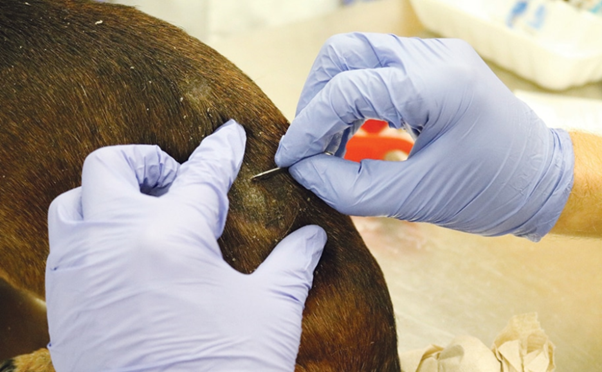
Deep skin scraping is considered the primary diagnostic method for detecting Demodex mites3.
Technique:
- Select representative lesions (preferably non-excoriated areas)
- Squeeze the skin to extrude mites from follicles
- Scrape until capillary bleeding is observed
- Transfer material onto a slide with mineral oil
Multiple scrapings from different sites may increase diagnostic yield.
Interpretation:
The presence of mites (adults, larvae, nymphs, or eggs) supports the diagnosis. Quantification may also help monitor treatment response over time1.
Trichography (Hair Pluck Examination)4
Trichograms may be useful in:
- Sensitive areas (e.g., periocular region, paws)
- Cases where scraping is difficult or poorly tolerated
Hair shafts are plucked and examined microscopically for mites. While less sensitive than deep scrapings, this method may still provide supportive evidence (Mueller et al., 2020).
Tape Impressions4
Acetate tape preparations may occasionally detect mites, particularly in oily or seborrheic areas. However, this technique is generally considered less reliable for diagnosing demodicosis.
Skin Biopsy1
Skin biopsy may be considered in:
- Chronic or atypical cases
- Cases with negative scrapings but high clinical suspicion
- Nodular or severe pododemodicosis
Histopathology may reveal mites within hair follicles and associated inflammatory changes.
Diagnostic Challenges1
Certain situations may complicate diagnosis:
- Pododemodicosis, where mites may be difficult to retrieve
- Chronic skin thickening or fibrosis
- Prior treatment reducing mite numbers
In such cases, repeated testing or alternative diagnostic methods may be required.
Monitoring and Follow-Up
Diagnostic testing is not limited to initial confirmation. Serial skin scrapings are recommended to:
- Monitor response to therapy
- Guide duration of treatment
- Confirm parasitological cure
Clinical improvement alone may not indicate complete resolution, making follow-up testing important1.
Clinical Relevance
A structured diagnostic approach enables:
- Early and accurate detection
- Differentiation from other dermatological conditions
- Objective monitoring of treatment response
Appropriate use of diagnostic tools supports evidence-based management and may improve clinical outcomes.
Reference
- Mueller RS, Rosenkrantz W, Bensignor E, Karaś‐Tęcza J, Paterson T, Shipstone MA. Diagnosis and treatment of demodicosis in dogs and cats: Clinical consensus guidelines of the World Association for Veterinary Dermatology. Veterinary dermatology. 2020 Feb;31(1):4-e2. https://ebvminpractice.org/wp-content/uploads/2025/09/veterinary-dermatology-2020-mueller-diagnosis-and-treatment-of-demodicosis-in-dogs-and-cats.pdf
- Salem NY, Abdel-Saeed H, Farag HS, Ghandour RA. Canine demodicosis: Hematological and biochemical alterations. Veterinary world. 2020 Jan 10;13(1):68. https://pmc.ncbi.nlm.nih.gov/articles/PMC7020110/pdf/Vetworld-13-68.pdf
- Nashat MA, Arbona RJ, Riedel ER, Francino O, Ferrer L, Luchins KR, Lipman NS. Comparison of diagnostic methods and sampling sites for the detection of Demodex musculi. Journal of the American Association for Laboratory Animal Science: JAALAS. 2018 Mar;57(2):173. https://pmc.ncbi.nlm.nih.gov/articles/PMC5868384/pdf/jaalas2018000173.pdf
- Suartha IN, Nainggolan WM, Sidjabat YR, Restiati NM. The comparison of scraping, trichogram, and taping techniques for diagnosis of demodicosis in dog. https://www.academia.edu/download/71405544/23117.pdf
Related Contents
.jpg)
Video
Transjugular Removal of Canine Heartworms: A Clinical and Surgical Overview
Transjugular removal of canine heartworms is a specialized intervention used in selected dogs with s...

Article
Feline Pregnancy Endocrinology: Hormonal Changes and Placental Function
Pregnancy in cats involves a distinctive endocrine pattern in which ovarian and placental hormones w...

Article
Hormonal Control of Pregnancy Termination in Cats
Pregnancy maintenance in cats depends strongly on coordinated hormonal support, particularly progest...

Article
Feline Embryo Implantation and Early Placental Development
Pregnancy establishment in cats involves a sequence of precisely timed events between fertilization,...

Article
Ultrasonographic Monitoring of Pregnancy in Cats: A Gestational Timeline
Ultrasonography provides a practical way to follow the progression of feline pregnancy by identifyin...

Article
Feline Mismating: Pregnancy Diagnosis and Clinical Management
Mismating or unplanned mating is a common clinical problem in sexually mature queen cats because of...

Article
Medical Termination of Pregnancy in Queens: Drugs, Timing and Treatment Protocols
Medical termination of pregnancy (MTP) in queen cats should be approached according to the timing of...

Article
Safety and Aftercare Following Pregnancy Termination in Queen Cats
Pregnancy termination in queen cats requires more than selecting an appropriate abortifacient. Once...