Article
Fish Vaccination in Aquaculture: Vaccine Selection and Administration for Disease Prevention
A sudden rise in mortality in a densely stocked fish population can quickly become a herd-health problem. Where bacterial pathogens can spread readily between fish, the question is not simply whether disease can be treated, but whether it can be prevented.
Vaccination has become an important disease-prevention approach in aquaculture. It can reduce reliance on antibiotics and chemotherapeutics, which are associated with drug resistance and consumer and environmental safety concerns[1]. Millions of fish are vaccinated annually, reflecting a shift towards immunisation for disease control in several parts of the world[2].
Which bacterial diseases can vaccination target?
The practical value of vaccination depends on the pathogen and the vaccine available for the relevant fish production system.
Commercial bacterial vaccines have been developed against important pathogens including Aeromonas salmonicida, Yersinia ruckeri and Vibrio anguillarum. The first successful commercial bacterial vaccine was introduced in the United States in the late 1970s against enteric redmouth disease and vibriosis, using whole-cell inactivation and immersion administration[2].
This history is clinically relevant because vaccination is not a universal substitute for disease management. Intensive aquaculture remains vulnerable to outbreaks when high stocking densities, temperature changes, hypoxia, and other stressful conditions facilitate pathogen transmission[2]. Vaccination therefore needs to sit within broader husbandry, biosecurity, nutrition and water-quality management.
Does the administration route matter?
Yes. Fish vaccines can be administered through immersion, oral, or injection-based routes, with each approach having specific applications in aquaculture.
Immersion has been particularly important in the development of fish vaccination. The first licensed commercial fish vaccine was a killed Yersinia ruckeri vaccine administered by immersion against enteric redmouth disease[3]. Formalin-killed immersion vaccines were subsequently developed for vibriosis in trout and salmon, while earlier salmonid vaccines also used immersion to prevent bacterial infections[4].
Oral vaccination has also been described. The first reported fish vaccine was a killed Aeromonas salmonicida oral vaccine in cutthroat trout (Oncorhynchus clarkii)[2],[5]. An orally administered recombinant vaccine targeting Streptococcus agalactiae in red hybrid tilapia produced a reported 70% relative percent survival, alongside a strong IgM response in serum, mucus and gut lavage fluid[6].
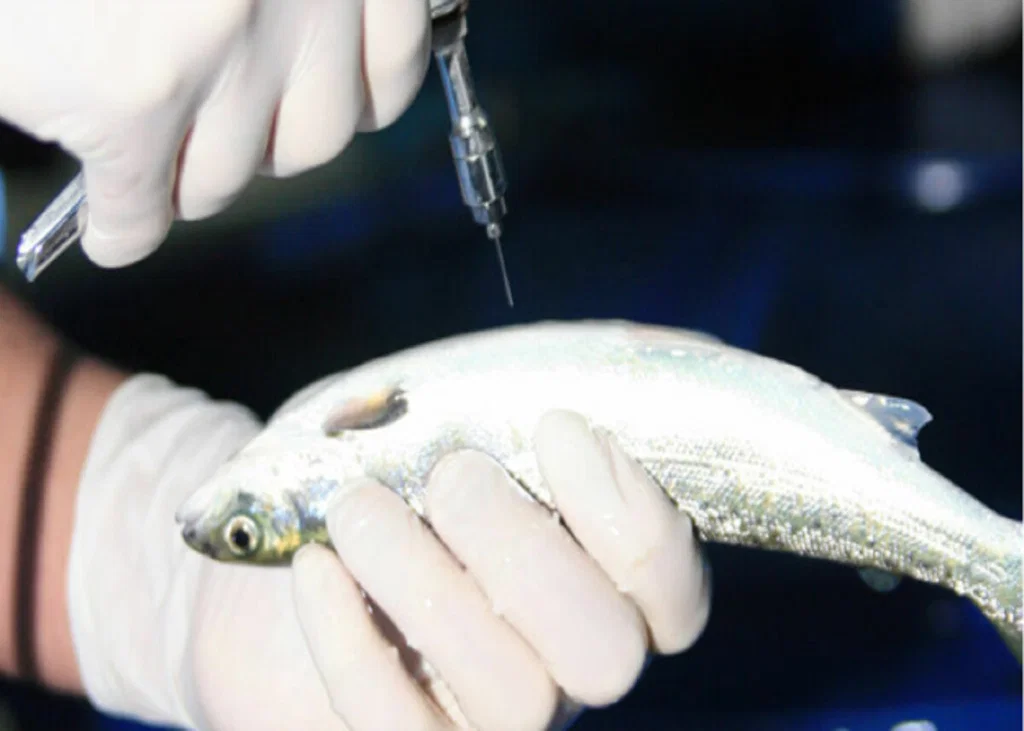
Injection provides another route. Intracoelomic immunisation protected Nile tilapia against a virulent wild-type strain of S. iniae, with a reported relative percent survival (RPS) of 95.05%[7].
What should veterinarians consider?
The practical choice is therefore not simply “vaccinate or do not vaccinate.” The relevant pathogen, available vaccine approach, fish species and administration method all matter.
Vaccination can form an important component of preventive disease management, but it should not be viewed in isolation. Maintaining appropriate husbandry, biosecurity, nutrition, genetics, system management and water quality remains essential in intensive fish production[8].
Clinical Bottom Line
For aquatic veterinarians, vaccination is best considered as one component of an integrated disease-prevention programme. The available evidence in the supplied content supports bacterial vaccination through different routes, but the appropriate approach depends on the specific pathogen, fish and production context rather than a single universally applicable strategy.
References:
- Manyi-Loh C, Mamphweli S, Meyer E, Okoh A. Antibiotic use in agriculture and its consequential resistance in environmental sources: potential public health implications. Molecules. 2018 Mar 30;23(4):795. https://www.mdpi.com/1420-3049/23/4/795
- Irshath AA, Rajan AP, Vimal S, Prabhakaran VS, Ganesan R. Bacterial pathogenesis in various fish diseases: recent advances and specific challenges in vaccine development. Vaccines. 2023 Feb 17;11(2):470. https://www.mdpi.com/2076-393X/11/2/470
- Fajardo C, Santos P, Passos R, Vaz M, Azeredo R, Machado M, Fernández-Boo S, Baptista T, Costas B. Functional and molecular immune response of rainbow trout (Oncorhynchus mykiss) following challenge with Yersinia ruckeri. International Journal of Molecular Sciences. 2022 Mar 13;23(6):3096. https://www.mdpi.com/1422-0067/23/6/3096
- Bøgwald J, Dalmo RA. Review on immersion vaccines for fish: An update 2019. Microorganisms. 2019 Nov 29;7(12):627. https://www.mdpi.com/2076-2607/7/12/627
- Menanteau-Ledouble S, Kumar G, Saleh M, El-Matbouli M. Aeromonas salmonicida: updates on an old acquaintance. Diseases of aquatic organisms. 2016 Jun 15;120:49-68. https://www.researchgate.net/profile/Gokhlesh-Kumar/publication/301536167
- Bøgwald J, Dalmo RA. Protection of teleost fish against infectious diseases through oral administration of vaccines: update 2021. International Journal of Molecular Sciences. 2021 Oct 10;22(20):10932. https://www.mdpi.com/1422-0067/22/20/10932
- Heckman TI, Shahin K, Henderson EE, Griffin MJ, Soto E. Development and efficacy of Streptococcus iniae live-attenuated vaccines in Nile tilapia, Oreochromis niloticus. Fish & Shellfish Immunology. 2022 Feb 1;121:152-62. https://www.sciencedirect.com/science/article/am/pii/S1050464821004599
- Muktar Y, Tesfaye S, Tesfaye B. Present status and future prospects of fish vaccination: a review. J. Vet. Sci. Technol. 2016;7(02):299. https://www.researchgate.net/profile/Shimels-Tesfaye/publication/312257799
Related Contents

Article
Chronic Cough in Dogs and Cats: How to Classify and Localize It
A dog has been coughing for several weeks. The owner describes it as “honking,” but the...
Article
Diagnosing the Coughing Dog or Cat: Choosing the Right Diagnostic Test
A coughing dog or cat does not automatically need every available respiratory test. The more useful...

Article
Bronchoscopy and Airway Sampling in Dogs and Cats with Chronic Cough
In dogs and cats with chronic cough, thoracic radiographs may not fully explain the airway abnormali...

Article
When Should Veterinarians Suppress Cough?
Cough suppression plays a specific role in managing respiratory diseases in dogs and cats. The aim i...

Article
Managing Persistent Cough in Dogs and Cats: From Conventional Therapy to Emerging Options
Persistent cough in dogs and cats may require more than treatment of the primary disease. When cough...
Article
Bacterial Diseases in Farmed Fish: Recognising Clinical Patterns in Practice
A fish population develops haemorrhagic lesions, lethargy and poor appetite. Another shows exophthal...
Article
Viral Diseases in Aquaculture: Recognising Clinical Patterns Before the Outbreak Escalates
A group of cultured fish begins showing dark skin, haemorrhage, anaemia and abnormal behaviour. In a...
Article
Parasitic Diseases in Farmed Fish: Recognising Gill, Skin and Systemic Involvement
A group of fingerlings is losing appetite and becoming increasingly inactive. Some fish have excessi...