Article
Viral Diseases in Aquaculture: Recognising Clinical Patterns Before the Outbreak Escalates
A group of cultured fish begins showing dark skin, haemorrhage, anaemia and abnormal behaviour. In another facility, mortality occurs among carp with few obvious external signs. Could these represent different viral diseases despite the apparently similar presentation?
Viral infections can affect aquaculture production and international trade, and their clinical expression depends on the virus, host susceptibility, environmental conditions and transmission dynamics. For practicing veterinarians, recognising characteristic disease patterns can help distinguish important viral differentials.
Why viral disease can be difficult to recognise
Viral infections are influenced by several interacting factors, including environmental sustainability, reservoir hosts, host susceptibility, transmission dynamics, and viral virulence[1].
Stress is another important consideration. Aquatic animals may experience conditions that contribute to long-standing viral infections[1]. Consequently, clinical assessment needs to consider both the affected fish and the conditions in which they are being maintained.
Several viral diseases can produce overlapping findings such as haemorrhage, anaemia, exophthalmia, skin changes, enlarged spleen, and abnormal behaviour. The combination of findings and the affected host become particularly useful when narrowing the differential.
Rhabdovirus diseases: Similar category, different patterns
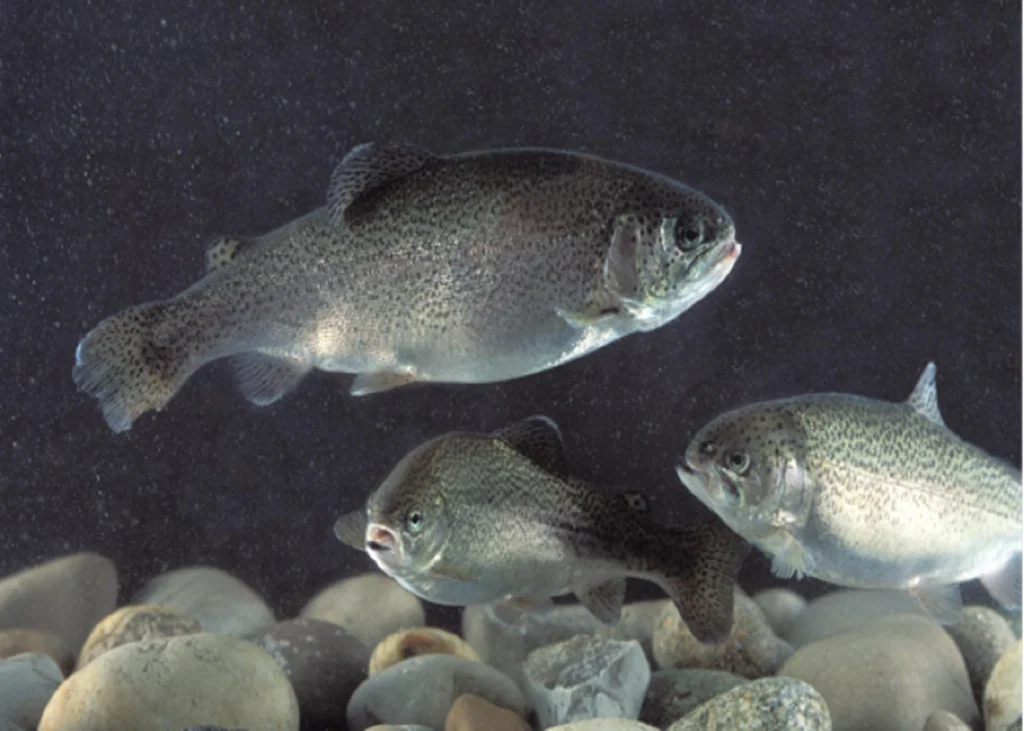
Infectious haematopoietic necrosis virus (IHNV) is a rhabdovirus with a negative-sense, single-stranded RNA genome and is an important pathogen of farmed rainbow trout. Changes associated with IHNV in rainbow trout aquaculture have included shifts in host specificity and severity[1].
Viral haemorrhagic septicaemia (VHS) is another rhabdovirus disease that can resemble IHNV. Initially isolated in Europe, VHS caused significant losses among rainbow trout in aquaculture. Subsequent virological surveys identified a broader host and geographic range in marine and cultured fish[1].
This distinction is clinically relevant: A haemorrhagic presentation alone does not establish VHS or IHNV. The host species and wider disease pattern need to be considered.
Carp showing disease? Consider SVC and KHV
Spring viremia of carp (SVC) is caused by spring viremia of carp virus (SVCV), an enveloped, bullet-shaped rhabdovirus. The disease initially occurred in Europe and subsequently emerged in North America and Asia, with surveillance and international ornamental fish trade contributing to its wider recognition and spread[2].
Koi herpesvirus disease (KHV), in contrast, is caused by a Cyprinivirus in the Alloherpesviridae family. It is relatively host-specific, affecting common carp and ornamental koi carp.
An important feature of KHV is that infected fish can persist in a latent or carrier state without clinical signs. The trade in cultured ornamental fish and introduction of KHV into wild populations have contributed to its rapid emergence and associated mortality[3].
When mortality occurs without an obvious external pattern
Epizootic haematopoietic necrosis virus (EHNV) is a large DNA virus belonging to the Ranavirus family. It causes mortality in farmed rainbow trout and native redfin perch.
Ranaviruses occur across amphibian, fish and reptile populations, and in finfish aquaculture, disease development can involve spill-over from domestic reservoirs[1].
This highlights an important clinical consideration: The absence of a striking external lesion does not exclude a significant viral disease problem.
Clinical bottom line
Viral disease assessment in aquaculture requires more than matching one clinical sign with one pathogen.
When haemorrhage, anaemia, exophthalmia, dark skin, abnormal behaviour, enlarged spleen or mortality occurs, consider:
- Which fish species are affected?
- Is the presentation acute or associated with persistent infection?
- Are there relevant environmental or stress conditions?
- Could carrier or reservoir hosts contribute to transmission?
Recognising these patterns can help veterinarians narrow the differential diagnosis and identify situations requiring closer disease investigation and control measures.
References:
- Senthamarai MD, Rajan MR, Bharathi PV. Current risks of microbial infections in fish and their prevention methods: A review. Microbial pathogenesis. 2023 Dec 1;185:106400. https://www.researchgate.net/profile/Rajan-Muthuswami-Ruby/publication/375006029
- Meng KF, Ding LG, Wu S, Wu ZB, Cheng GF, Zhai X, Sun RH, Xu Z. Interactions between commensal microbiota and mucosal immunity in teleost fish during viral infection with SVCV. Frontiers in immunology. 2021 Apr 7;12:654758. https://www.frontiersin.org/journals/immunology/articles/10.3389/fimmu.2021.654758/pdf
- Padhi SK, Tolo I, McEachran M, Primus A, Mor SK, Phelps NB. Koi herpesvirus and carp oedema virus: Infections and coinfections during mortality events of wild common carp in the United States. Journal of Fish Diseases. 2019 Nov;42(11):1609-21. https://www.researchgate.net/profile/Isaiah-Tolo-3/publication/336729927
Related Contents

Article
Chronic Cough in Dogs and Cats: How to Classify and Localize It
A dog has been coughing for several weeks. The owner describes it as “honking,” but the...
Article
Diagnosing the Coughing Dog or Cat: Choosing the Right Diagnostic Test
A coughing dog or cat does not automatically need every available respiratory test. The more useful...

Article
Bronchoscopy and Airway Sampling in Dogs and Cats with Chronic Cough
In dogs and cats with chronic cough, thoracic radiographs may not fully explain the airway abnormali...

Article
When Should Veterinarians Suppress Cough?
Cough suppression plays a specific role in managing respiratory diseases in dogs and cats. The aim i...
Article
Managing Persistent Cough in Dogs and Cats: From Conventional Therapy to Emerging Options
Persistent cough in dogs and cats may require more than treatment of the primary disease. When cough...
Article
Bacterial Diseases in Farmed Fish: Recognising Clinical Patterns in Practice
A fish population develops haemorrhagic lesions, lethargy and poor appetite. Another shows exophthal...
Article
Parasitic Diseases in Farmed Fish: Recognising Gill, Skin and Systemic Involvement
A group of fingerlings is losing appetite and becoming increasingly inactive. Some fish have excessi...
Article
Fungal and Oomycete Infections in Fish: Recognising Environmental and Clinical Triggers
Fungal disease in a fish population may appear after another illness, mechanical injury, or a period...