Article
Choosing the Right Fracture Fixation in Cats: ESF vs Plate vs ILN
Selecting the appropriate fixation method in cats depends on fracture location and pattern, the cat’s overall health, and the surgeon’s expertise. The goal is to have stable bone healing with minimal complications.
Comparison of Fixation Methods
|
Feature |
External Skeletal Fixator (ESF) |
Bone Plate / Plate-Rod |
Interlocking Nail (ILN) |
|
Indications / Typical Location |
Open or contaminated fractures; nonunion cases; lower limb fractures where soft tissue preservation is important1,2 |
Complex or periarticular fractures; long bones requiring anatomical reconstruction4 |
Suitable for diaphyseal long-bone fractures of femur and tibia when canal size permits5. |
|
Surgical Approach |
Minimally invasive pin placement, preserving soft tissue and vascularity1,2 |
Open or limited open approach; allows precise anatomical reduction4 |
Limited surgical approach; supports biological fixation by preserving soft tissues5. |
|
Biomechanics / Stability |
Provides bridging stability; allows gradual dynamization for bone healing1 |
Provides rigid fixation; modern plates provide excellent anatomical alignment4 |
Offers superior bending & torsional resistance to IM pins; works near neutral axis for better load sharing5. |
|
Complications |
Minor complications common, e.g., superficial pin-tract infection or implant failure1,2,3 |
Risk of soft-tissue disruption and infection exists; complication rates generally low in modern plate systems4 |
Limitations include narrow medullary canals and implant availability5. |
|
Healing Biology |
Supports secondary (callus) healing; preserves soft tissue for biological repair1 |
Allows primary bone healing with precise anatomical reduction4 |
Encourages secondary healing via relative stability and preserved biology5. |
Key Considerations in Choosing the Optimal Fixation
1. Fracture Location and Pattern
- Diaphyseal mid-shaft fractures: ILNs are highly effective when bone size permits.
- Metaphyseal or periarticular fractures: Plates provide superior alignment and joint surface control.
- Comminuted fractures with soft-tissue trauma: ESF or MIPO plating are preferred for biological repair.
2. Soft-Tissue Status
- Open wounds, contamination, or high infection risk strongly favor ESFs or staged external fixation followed by internal fixation.
3. Cat-Specific Factors
- Cats with high activity levels may damage external fixators.
- Poor bone quality (e.g., due to malnutrition) requires implants providing maximum rigidity, often plates.
4. Owner Compliance
Post-operative care varies significantly:
- ESF demands pin-site cleaning.
- Plates and ILNs require more initial surgical investment but low daily maintenance.
5. Surgeon Expertise and Equipment
- ILN systems need fluoroscopy or experienced freehand technique.
- Plating demands excellent anatomical reconstruction skills.
- ESF requires understanding of frame geometry for optimal stiffness.
Clinical Guidance
- Diaphyseal fractures: ILNs are effective for mid-shaft fractures, minimizing soft-tissue disruption while providing mechanical stability.
- Periarticular or complex fractures: Bone plating remains ideal for precise anatomical reconstruction and joint preservation.
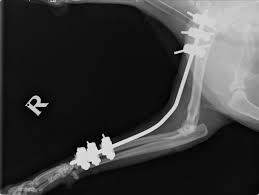
- Open or contaminated fractures / nonunion: ESFs, particularly linear or novel systems, reduce infection risk and allow staged dynamization.
- Hybrid constructs: Tied-in ESF with intramedullary pin can be applied for additional stability in challenging fractures.
References
- Uygur S, Doğan A, Yıldız Doğan M, Qoti F, Yardımcı C. Use of a novel external skeletal fixation system (Exvet) for long bone fracture stabilization in young cats. VCOT Open. 2025;8:e56–e70. Available from: https://www.thieme-connect.com/products/ejournals/pdf/10.1055/a-2552-5934.pdf
- Gülaydin A. Treatment of nonunion cases with linear external fixation in cats: 10 cases (2022–2023). Am J Vet Res. 2025 Mar 1;86(3).
- Beever L, Giles K, Meeson R. Postoperative complications associated with external skeletal fixators in cats. J Feline Med Surg. 2017;19(7):727–36. Available from: https://pmc.ncbi.nlm.nih.gov/articles/PMC11129199/
- Labib MTR, Mahmud MA, Rahman MA, Rahman MT. Management of long bone fractures in cats using bone plating system. J Bangladesh Agric Univ. 2025;23(3):377–85. Available from: https://www.banglajol.info/index.php/JBAU/article/view/84517
- Zurita M, Craig A. Feline diaphyseal fractures: management and treatment options. J Feline Med Surg. 2022;24(7):662–74. doi:10.1177/1098612X211067528
Related Contents
.jpg)
Video
Transjugular Removal of Canine Heartworms: A Clinical and Surgical Overview
Transjugular removal of canine heartworms is a specialized intervention used in selected dogs with s...

Article
Feline Pregnancy Endocrinology: Hormonal Changes and Placental Function
Pregnancy in cats involves a distinctive endocrine pattern in which ovarian and placental hormones w...

Article
Hormonal Control of Pregnancy Termination in Cats
Pregnancy maintenance in cats depends strongly on coordinated hormonal support, particularly progest...

Article
Feline Embryo Implantation and Early Placental Development
Pregnancy establishment in cats involves a sequence of precisely timed events between fertilization,...

Article
Ultrasonographic Monitoring of Pregnancy in Cats: A Gestational Timeline
Ultrasonography provides a practical way to follow the progression of feline pregnancy by identifyin...

Article
Feline Mismating: Pregnancy Diagnosis and Clinical Management
Mismating or unplanned mating is a common clinical problem in sexually mature queen cats because of...

Article
Medical Termination of Pregnancy in Queens: Drugs, Timing and Treatment Protocols
Medical termination of pregnancy (MTP) in queen cats should be approached according to the timing of...

Article
Safety and Aftercare Following Pregnancy Termination in Queen Cats
Pregnancy termination in queen cats requires more than selecting an appropriate abortifacient. Once...