Article
Preventing Ovine Footrot: Biosecurity, Vaccination, and Flock Control Strategies
Ovine footrot remains one of the most important infectious causes of lameness in sheep, affecting animal welfare, flock productivity, and farm profitability. The disease spreads efficiently under favourable environmental conditions and can persist within flocks through clinically affected as well as carrier animals. While treatment is essential for affected sheep, long-term success depends on a comprehensive flock-level control strategy that combines biosecurity, surveillance, vaccination where appropriate, and management practices aimed at preventing reinfection. A practical understanding of these control measures enables veterinarians to design programmes that suit different production systems while reducing disease transmission and improving flock health.
Establishing an Effective Biosecurity Plan
Preventing the introduction of Dichelobacter nodosus into disease-free flocks is the cornerstone of footrot control. Strict biosecurity should begin before new animals enter the flock. Quarantine of newly purchased sheep, together with laboratory testing for virulent D. nodosus, helps identify infected or carrier animals before they become a source of infection. Avoiding co-mingling with other flocks during grazing, exhibitions, and livestock gatherings further reduces the likelihood of disease introduction1.
Transmission between flocks commonly occurs through movement of infected sheep or contamination of shared environments such as markets and exhibitions2. Molecular typing has also highlighted the importance of animal movement in spreading footrot across regions3,4.
Within affected flocks, attention should also be paid to iatrogenic transmission. Trimming equipment can spread D. nodosus between animals if not adequately disinfected. Cleaning trimming blades with disposable disinfectant towels containing 60% ethanol after every sheep, followed by additional decontamination procedures, markedly reduces bacterial contamination. Disposable gloves should be changed between animals, and all hoof trimmings should be collected and disposed of appropriately2.
Flock-Level Control Measures
Successful footrot control requires a coordinated approach rather than reliance on a single intervention. Depending on flock size, production system, climate, and available resources, veterinarians may recommend combinations of:
- Prompt treatment of clinically affected sheep.
- Regular footbathing.
- Appropriate antimicrobial therapy where justified.
- Culling of chronically infected animals.
- Vaccination.
- Selection of animals with greater resistance to footrot2,5
The primary objective may be to reduce disease severity and incidence or to eliminate footrot from the flock altogether. In regions with climatic conditions that strongly favour transmission, eradication is more challenging and requires sustained, labour-intensive management programmes1. Different countries have achieved favourable outcomes using strategies centred on antibiotic treatment or intensive footbathing programmes2,5,6.
Culling chronically infected sheep remains a key component of successful control programmes because these animals can maintain infection within the flock7,8. In some situations involving heavily infected flocks, complete destocking has also been implemented successfully9.
Vaccination: Matching the Strategy to the Flock
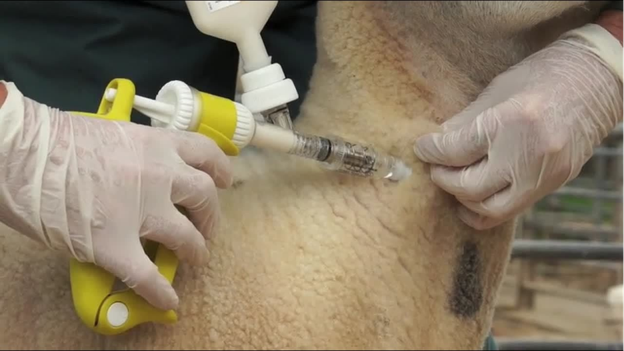
Vaccination has played an important role in flock-level control, particularly in Australia. However, successful vaccination depends on understanding the circulating serogroups within the flock. Simultaneous vaccination against multiple serogroups may lead to immunological competition and reduced protection, making serogroup identification an important first step2.
Mono- and bivalent vaccines targeting one or two serogroups have successfully eliminated footrot within four years in several countries, including Australia, Bhutan, and Nepal. Immunity typically persists for 12–16 weeks, providing protection during periods of disease transmission. Where multiple serogroups circulate, sequential administration of mono- or bivalent vaccines at three-month intervals has also proved effective2.
Multivalent vaccines remain useful as supportive control tools, although immunity is generally shorter, lasting around 10 weeks, and complete elimination is achieved less consistently1,2. Injection-site swelling, particularly with oil-based adjuvants or improper injection technique, should be anticipated and discussed with flock owners2.
Practical Clinical Insights
- Prioritise quarantine and laboratory testing before introducing replacement sheep.
- Minimise disease spread by disinfecting trimming equipment and changing gloves between animals.
- Remove chronically infected sheep to reduce persistent sources of infection.
- Select vaccination protocols according to the serogroups circulating within the flock rather than relying on broad vaccination alone.
- Tailor control programmes to local climatic conditions, flock management practices, and available resources, recognising that sustained, coordinated measures provide the greatest opportunity for long-term disease control.
References
- Abbott KA, Lewis CJ. Current approaches to the management of ovine footrot. The Veterinary Journal. 2005 Jan 1;169(1):28-41. https://www.researchgate.net/profile/Kym-Abbott-2/publication/8048119_Current_approaches_to_the_management_of_ovine_footrot/links/5dc359fd4585151435ef6068/Current-approaches-to-the-management-of-ovine-footrot.pdf
- Zanolari P, Dürr S, Jores J, Steiner A, Kuhnert P. Ovine footrot: A review of current knowledge. The Veterinary Journal. 2021 May 1;271:105647. https://www.sciencedirect.com/science/article/pii/S1090023321000423
- Gilhuus M, Kvitle B, L’Abée-Lund TM, Vatn S, Jørgensen HJ. A recently introduced Dichelobacter nodosus strain caused an outbreak of footrot in Norway. Acta Veterinaria Scandinavica. 2014 May 13;56(1):29. https://link.springer.com/content/pdf/10.1186/1751-0147-56-29.pdf
- Russell CL, Smith EM, Calvo-Bado LA, Green LE, Wellington EM, Medley GF, Moore LJ, Grogono-Thomas R. Multiple locus VNTR analysis highlights that geographical clustering and distribution of Dichelobacter nodosus, the causal agent of footrot in sheep, correlates with inter-country movements. Infection, Genetics and Evolution. 2014 Mar 1;22:273-9. https://www.sciencedirect.com/science/article/pii/S1567134813002232
- Grant C, Kaler J, Ferguson E, O’Kane H, Green LE. A comparison of the efficacy of three intervention trial types: postal, group, and one-to-one facilitation, prior management and the impact of message framing and repeat messages on the flock prevalence of lameness in sheep. Preventive Veterinary Medicine. 2018 Jan 1;149:82-91. https://wrap.warwick.ac.uk/id/eprint/94697/1/WRAP-comparison-efficacy-intervention-flock-prevalence-sheep-Green-2017.pdf
- Wassink GJ, King EM, Grogono-Thomas R, Brown JC, Moore LJ, Green LE. A within farm clinical trial to compare two treatments (parenteral antibacterials and hoof trimming) for sheep lame with footrot. Preventive veterinary medicine. 2010 Aug 1;96(1-2):93-103. https://wrap.warwick.ac.uk/id/eprint/3354/1/WRAP_Green_A_clinical_trial_of_two_treatments_Green_-_PMVrevision_WRAP.pdf
- Winter AC. Treatment and control of hoof disorders in sheep and goats. Veterinary Clinics: Food Animal Practice. 2011 Mar 1;27(1):187-92. https://www.academia.edu/download/38507866/winter2011.pdf
- Witt J, Green L. Development and assessment of management practices in a flock-specific lameness control plan: A stepped-wedge trial on 44 English sheep flocks. Preventive veterinary medicine. 2018 Sep 1;157:125-33. https://wrap.warwick.ac.uk/id/eprint/105224/1/WRAP-Development-assessment-management-practicwes-in-flock-specific-Green-2018.pdf
- Mills K, McClenaughan P, Morton A, Alley D, Lievaart J, Windsor PA, Egerton JR. Effect on time in quarantine of the choice of program for eradication of footrot from 196 sheep flocks in southern New South Wales. Australian veterinary journal. 2012 Jan;90(1‐2):14-9. https://researchoutput.csu.edu.au/files/8819372/31227manuscript.pdf
Related Contents
.jpg)
Video
Transjugular Removal of Canine Heartworms: A Clinical and Surgical Overview
Transjugular removal of canine heartworms is a specialized intervention used in selected dogs with s...

Article
Feline Pregnancy Endocrinology: Hormonal Changes and Placental Function
Pregnancy in cats involves a distinctive endocrine pattern in which ovarian and placental hormones w...

Article
Hormonal Control of Pregnancy Termination in Cats
Pregnancy maintenance in cats depends strongly on coordinated hormonal support, particularly progest...

Article
Feline Embryo Implantation and Early Placental Development
Pregnancy establishment in cats involves a sequence of precisely timed events between fertilization,...

Article
Ultrasonographic Monitoring of Pregnancy in Cats: A Gestational Timeline
Ultrasonography provides a practical way to follow the progression of feline pregnancy by identifyin...

Article
Feline Mismating: Pregnancy Diagnosis and Clinical Management
Mismating or unplanned mating is a common clinical problem in sexually mature queen cats because of...

Article
Medical Termination of Pregnancy in Queens: Drugs, Timing and Treatment Protocols
Medical termination of pregnancy (MTP) in queen cats should be approached according to the timing of...

Article
Safety and Aftercare Following Pregnancy Termination in Queen Cats
Pregnancy termination in queen cats requires more than selecting an appropriate abortifacient. Once...