Article
Home Physiotherapy for Dogs with Osteoarthritis: Practical Exercises to Support Mobility
Canine osteoarthritis (OA) is a chronic, progressive condition that affects mobility, comfort, and overall quality of life. While pharmacological management remains an important component of treatment, physiotherapy performed at home can play a valuable supportive role in maintaining function and encouraging regular movement. Home-based exercises provide an opportunity for owners to participate actively in their dog's long-term care, while reinforcing the goals established by the veterinary team. Success depends on selecting exercises appropriate for the individual patient, ensuring adequate pain control, and maintaining consistency over time1,2,3.
A structured home physiotherapy programme should complement, rather than replace, veterinary assessment and ongoing clinical monitoring.
Building an Effective Home Exercise Programme
Home exercises should be individualized according to the affected joints, the dog's physical capabilities, disease severity, and the owner's ability to perform the prescribed techniques correctly. Programmes that include strengthening, proprioceptive training, balance exercises, and massage can be incorporated into daily routines while remaining practical for most households1,2.
Owners should receive clear instruction to ensure exercises are performed safely and without causing discomfort. Because most owners have limited knowledge of canine anatomy and joint mechanics, simple active exercises that rely on the dog's natural movements are preferred over exercises requiring specialized equipment. Manual therapy techniques requiring advanced skills should remain the responsibility of trained veterinary physiotherapists1.
Strengthening Exercises for Functional Mobility
Muscle weakness contributes to reduced joint stability and impaired mobility in osteoarthritic patients. Strengthening exercises therefore form an important component of home physiotherapy and are routinely recommended in clinical practice for dogs with OA1.
Resistance exercises may utilize the dog's own body weight, such as sit-to-stand exercises, or controlled resistance using elastic bands or carpal weights where appropriate1. Regular walking remains one of the most practical strengthening activities, supporting muscle conditioning, aerobic fitness, and weight management simultaneously1. Walking over different terrains and incorporating gentle inclines can further modify muscle activation and joint movement while allowing exercise to be tailored to individual patients4,5,6.
Improvement from strengthening programmes is expected to develop gradually over weeks to months and requires continued participation to maintain benefits1.
Passive Range of Motion and Stretching
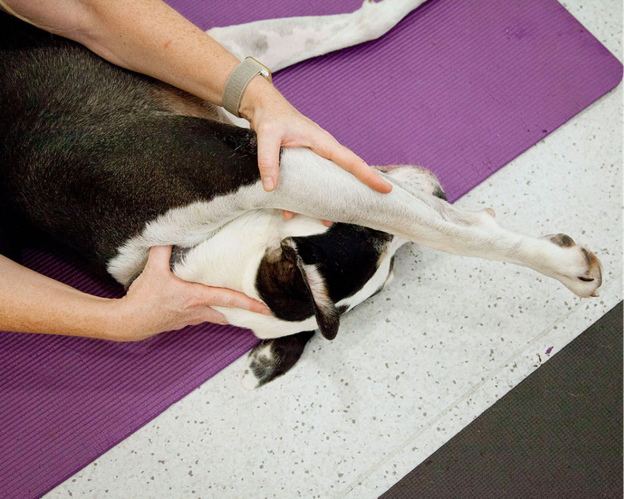
Although active exercise is preferred whenever tolerated, passive range of motion (PROM) techniques continue to have a place within selected home programmes. PROM involves moving a joint through its available range without active muscle contraction by the patient1.
Passive stretching of osteoarthritic elbow, carpal, and stifle joints performed twice daily for 21 days has been shown to improve joint range of motion1. However, current evidence primarily supports improved flexibility rather than enhanced muscle strength. Consequently, PROM should be viewed as a supportive intervention rather than a primary therapeutic exercise1,7.
Balance, Proprioception, and Massage
Balance and proprioceptive exercises are easy to incorporate into home routines and may support body control and functional mobility. Although direct evidence in osteoarthritic dogs remains limited, these exercises continue to be recommended while further evidence develops1,8,9.
Massage is another practical addition to home care. Gentle massage may help improve muscular relaxation, joint flexibility, and patient comfort while also encouraging owner involvement in long-term management1. Owners should receive appropriate instruction before incorporating massage into their dog's daily routine.
Practical Clinical Insights
- Design home exercise programmes around the individual dog's mobility, affected joints, and pain status.
- Encourage regular, low-impact activity rather than intermittent vigorous exercise.
- Reinforce owner education, as correct technique and long-term compliance are essential for successful home physiotherapy.
- Prefer active exercises whenever tolerated, using passive techniques as supportive interventions.
- Reassess patients periodically and modify home programmes as clinical signs change over time.
Home physiotherapy is most effective when integrated into a multimodal OA management plan. By combining strengthening exercises, controlled walking, selected passive techniques, balance training, and owner education, veterinarians can help maintain mobility while promoting realistic, sustainable long-term care for dogs living with osteoarthritis.
References
1. Mille MA, McClement J, Lauer S. Physiotherapeutic strategies and their current evidence for canine osteoarthritis. Veterinary sciences. 2022 Dec 21;10(1):2. https://www.mdpi.com/2306-7381/10/1/2
2. Abbott JH, Robertson MC, Chapple C, Pinto D, Wright AA, De La Barra SL, Baxter GD, Theis JC, Campbell AJ, MOA Trial Team. Manual therapy, exercise therapy, or both, in addition to usual care, for osteoarthritis of the hip or knee: a randomized controlled trial. 1: clinical effectiveness. Osteoarthritis and cartilage. 2013 Apr 1;21(4):525-34. https://www.sciencedirect.com/science/article/pii/S1063458413000034
3. French HP, Cusack T, Brennan A, Caffrey A, Conroy R, Cuddy V, FitzGerald OM, Gilsenan C, Kane D, O'Connell PG, White B. Exercise and manual physiotherapy arthritis research trial (EMPART) for osteoarthritis of the hip: a multicenter randomized controlled trial. Archives of physical medicine and rehabilitation. 2013 Feb 1;94(2):302-14. https://www.archives-pmr.org/article/S0003-9993(12)01018-0/pdf
4. Carrier DR, Deban SM, Fischbein T. Locomotor function of forelimb protractor and retractor muscles of dogs: evidence of strut-like behavior at the shoulder. Journal of Experimental Biology. 2008 Jan 1;211(1):150-62. https://digitalcommons.usf.edu/cgi/viewcontent.cgi?article=1300&context=bin_facpub
5. Deban SM, Schilling N, Carrier DR. Activity of extrinsic limb muscles in dogs at walk, trot and gallop. Journal of Experimental Biology. 2012 Jan 15;215(2):287-300. https://carrier.biology.utah.edu/Dave%27s%20PDF/Deban%20extrinsic%20muscles.pdf
6. Holler PJ, Brazda V, Dal-Bianco B, Lewy E, Mueller MC, Peham C, Bockstahler BA. Kinematic motion analysis of the joints of the forelimbs and hind limbs of dogs during walking exercise regimens. American journal of veterinary research. 2010 Jul 1;71(7):734-40. https://www.researchgate.net/profile/Christian-Peham/publication/44900733
7. McAlindon TE, Bannuru RR, Sullivan MC, Arden NK, Berenbaum F, Bierma-Zeinstra SM, Hawker GA, Henrotin Y, Hunter DJ, Kawaguchi H, Kwoh K. OARSI guidelines for the non-surgical management of knee osteoarthritis. Osteoarthritis and cartilage. 2014 Mar 1;22(3):363-88. https://www.sciencedirect.com/science/article/pii/S1063458414000168
8. López S, Vilar JM, Rubio M, Sopena JJ, Damiá E, Chicharro D, Santana A, Carrillo JM. Center of pressure limb path differences for the detection of lameness in dogs: a preliminary study. BMC veterinary research. 2019 May 8;15(1):138. https://link.springer.com/content/pdf/10.1186/s12917-019-1881-1.pdf
9. Levinger P, Dunn J, Bifera N, Butson M, Elias G, Hill KD. High-speed resistance training and balance training for people with knee osteoarthritis to reduce falls risk: study protocol for a pilot randomized controlled trial. Trials. 2017 Aug 18;18(1):384. https://link.springer.com/content/pdf/10.1186/s13063-017-2129-7.pdf
Related Contents
Article
Chronic Cough in Dogs and Cats: How to Classify and Localize It
A dog has been coughing for several weeks. The owner describes it as “honking,” but the...
Article
Diagnosing the Coughing Dog or Cat: Choosing the Right Diagnostic Test
A coughing dog or cat does not automatically need every available respiratory test. The more useful...
Article
Bronchoscopy and Airway Sampling in Dogs and Cats with Chronic Cough
In dogs and cats with chronic cough, thoracic radiographs may not fully explain the airway abnormali...
Article
When Should Veterinarians Suppress Cough?
Cough suppression plays a specific role in managing respiratory diseases in dogs and cats. The aim i...
Article
Managing Persistent Cough in Dogs and Cats: From Conventional Therapy to Emerging Options
Persistent cough in dogs and cats may require more than treatment of the primary disease. When cough...
Article
Bacterial Diseases in Farmed Fish: Recognising Clinical Patterns in Practice
A fish population develops haemorrhagic lesions, lethargy and poor appetite. Another shows exophthal...
Article
Viral Diseases in Aquaculture: Recognising Clinical Patterns Before the Outbreak Escalates
A group of cultured fish begins showing dark skin, haemorrhage, anaemia and abnormal behaviour. In a...
Article
Parasitic Diseases in Farmed Fish: Recognising Gill, Skin and Systemic Involvement
A group of fingerlings is losing appetite and becoming increasingly inactive. Some fish have excessi...